

Key Takeaways
- Learn more about the role of a healthcare data analyst.
- Find out why the jobs for healthcare data analysts are on the rise.
- Read about the salaries for different experiences and in different countries.
- Know more about the skills that can help you increase your earning potential.
If you’re in the healthcare industry, chances are you already know about the role of healthcare data analyst. With the healthcare industry growing at an exponential rate, the data generated is enormous. And that’s where the role of a healthcare data analyst starts.
Jobs are on the rise, and the market is stable. But there is one important thing you should consider before stepping into healthcare analytics: the salary.
It’s a fair question. The healthcare costs are rising, and there is a push toward data-driven decision-making. In this new age, healthcare analytics has become one of the most stable and future-proof career paths.
Let’s break down salaries and the career scope of healthcare data analysts.
Role of a Healthcare Data Analyst
A healthcare data analyst does not have a single job setting. They work with:
- Hospitals and healthcare systems
- Public health departments
- Consulting firms
- Insurance companies
- Pharmaceutical companies
The goal is to help organizations make smarter decisions. They often work on:
- Hospital records
- Insurance claims
- Patient outcomes
- Operational data
They analyze trends and improve patient care processes. They help reduce healthcare costs and sometimes even support life-saving research.
Healthcare Data Analyst Salary Snapshot- 2026
Healthcare data analytics is a job with many fronts. There are different data, different locations and obviously the experience levels. All these impact your salary. Let’s see how salary changes over these parameters.
Average Salary by Experience
| Experience Level | Average Salary in INR |
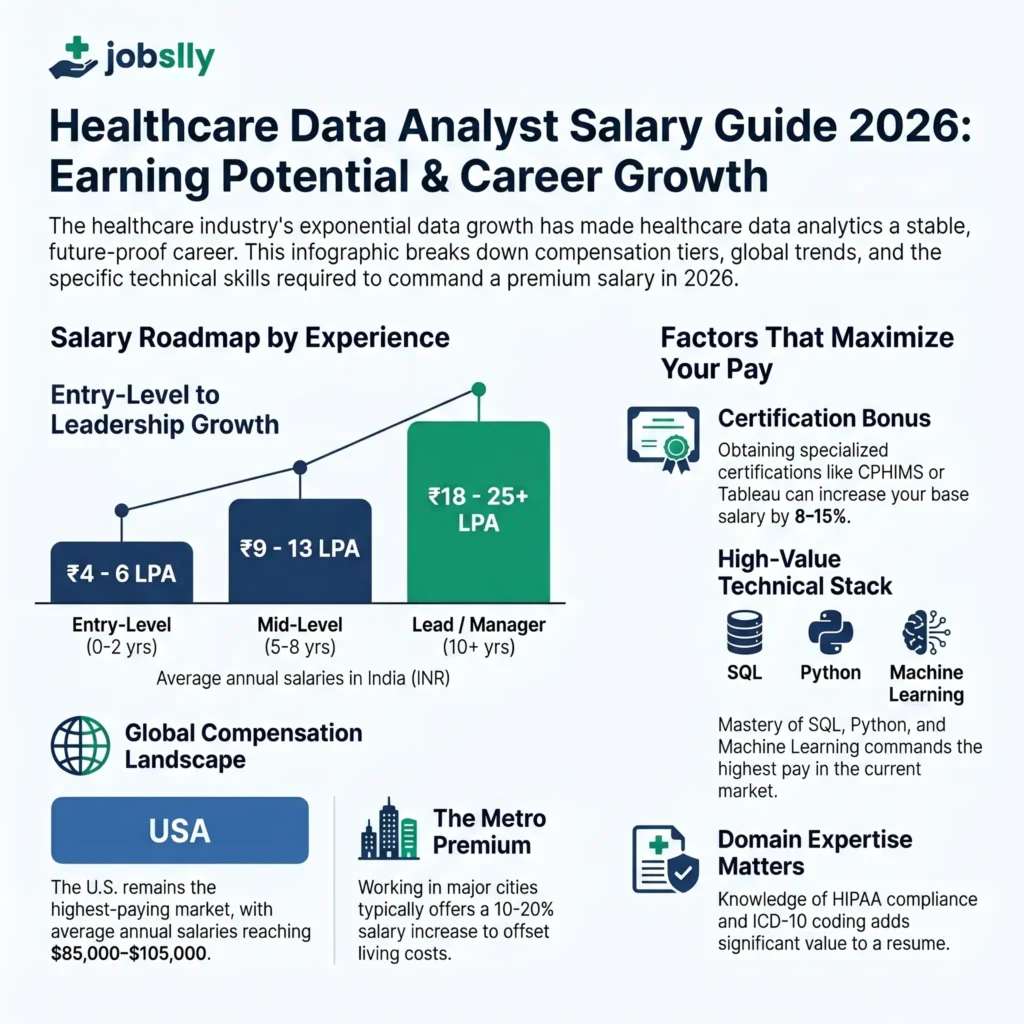
| Entry-Level (0 – 2 yrs) | ₹4 – 6 LPA |
| Early to Mid-Level (3 – 4 yrs) | ₹6 – 9 LPA |
| Mid Level (5 – 8 yrs) | ₹9 – 13 LPA |
| Senior Level (8 – 10 yrs) | ₹13 – 18 LPA |
| Lead/Manager | ₹18 – 25+ LPA |
In bigger cities, salaries can be 10 to 20% higher. This is to compensate for the demand and cost of living.
In India, many healthcare analytics aspirants start with internships or part-time research roles. Stipends for these also vary based on companies and locations:
| Internship Type | Monthly Stipend (INR) |
| College-linked Intern | ₹8,000 – ₹15,000 |
| Startup / Research Intern | ₹15,000 – ₹30,000 |
| Short-term Project | ₹20,000 – ₹40,000 |
Market Demand: Why Salaries Keep Rising
In the healthcare sector, there is a growing demand for:
- Reduction in operational costs
- Improvement in patient outcomes
- Compliance with regulations
- Adoption of AI and predictive modeling
Electronic Health Records generate huge datasets daily. Organizations need data analysts who can interpret this data.
Also, the healthcare system is expanding. The reasons range from an aging population to rise in chronic diseases. This makes analytics talent even more valuable.
Factors That Influence Salary
Not all healthcare data analysts earn the same. Here’s what makes a difference:
1. Certifications
Certifications can increase salary by 8–15%, like:
- Certification in Health Data Analytics
- Certified Professional in Healthcare Information and Management Systems (CPHIMS)
- Tableau or Power BI certifications
2. Technical Stack
Professionals skilled in:
- SQL
- Python
- R
- Machine Learning
- Healthcare-specific tools like Epic or Cerner
tend to command higher pay.
3. Domain Knowledge
If you have an understanding of
- Healthcare billing codes (ICD-10)
- HIPAA compliance
- Value-based care models
You can add even more value to your resume.
A Less Discussed Reality: Salary Growth Isn’t Always Linear
One of the overlooked points is that the salary growth in healthcare analytics often plateaus unless you move into leadership or specialization.
For example:
- Moving into predictive modeling
- Transitioning to healthcare data science
- Managing analytics teams
- Shifting into healthcare consulting
Without this transition, annual raises may slow down after 5 to 7 years.
Remote Work and Its Impact on Pay
Remote healthcare analytics roles increased significantly after 2020. However, some organizations now adjust pay based on your location.
That means:
- Living in a lower-cost city might slightly reduce salary.
- Specialized skills can help maintain higher compensation regardless of geography.
Contract vs Full-Time Roles
Another angle most blogs skip: contract analytics roles.
| Employment Type | Salary Impact |
| Full-Time | Stable benefits, steady growth |
| Contract (1099) | 15–30% higher hourly rate |
| Consulting | Potentially highest pay, less job security |
Some senior analysts earn $60–$90 (INR 5400 – 8100) per hour as contractors. But this comes without benefits. So long-term planning is important.
International Salary Trends
Healthcare analytics salaries vary globally:
| Country | Average Annual Salary |
| United States | $85,000 – $105,000 |
| Canada | $70,000 – $90,000 |
| United Kingdom | £40,000 – £65,000 |
| India | ₹6,00,000 – ₹15,00,000 |
The U.S. remains the highest paying country. However, other countries are catching up fast.
Skills To Increase Earning Potential
Here are some factors that can increase your long-term income:
- Communication skills
- Regulatory knowledge
- Understanding healthcare compliance frameworks.
- Process improvement expertise
- Interdisciplinary understanding
In healthcare, soft skills really matter.
Career Growth Path
Here’s a typical progression:
Healthcare Data Analyst → Senior Analyst → Analytics Manager → Director of Healthcare Analytics → Chief Healthcare Data Officer
Each step significantly increases your salary.
Is It Worth It?
The answer is a resounding yes. Healthcare data analytics is an excellent career option. You get a stable career and high salaries. Not only that, but the work itself is meaningful and impacts patient care.
There is a growing demand for healthcare data analysts. If you are on the lookout for a healthcare job, this can be your chance.
Focus on understanding the healthcare ecosystem itself. That’s where real earning potential lies.
FAQs
Q- Does certification increase salary?
A- Yes, certifications can boost earnings by 8–15%.
Q- Is healthcare analytics recession-proof?
A- It’s more stable than many industries because healthcare demand remains constant.
Q- Can healthcare data analysts work remotely?
A- Yes, many roles now offer hybrid or fully remote options.
Q- Which skills pay the most in this field?
A- SQL, Python, machine learning, and healthcare compliance knowledge.
Q- Is a master’s degree required?
A- Not always, but it can accelerate career progression.
Q- How long does it take to reach six figures?
A- Usually 3–6 years with consistent skill development.
Q- Is this career stressful?
A- It can be deadline-driven, but generally offers better work-life balance than clinical roles.
